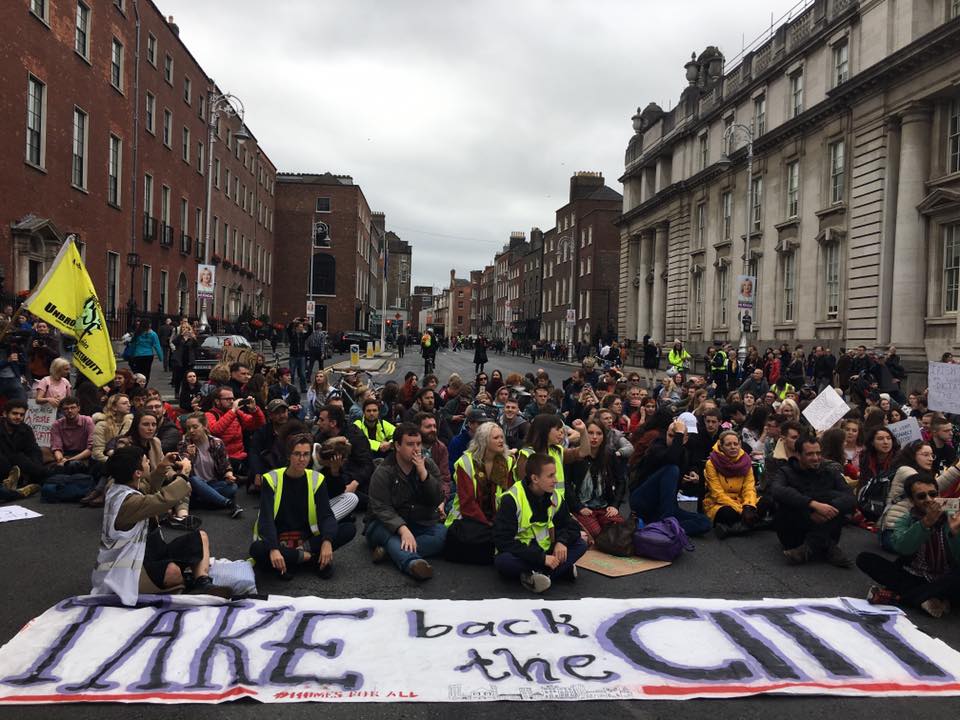
On November the 29th, housing activists from various groups, working under the Take Back The City group, took to Ha’penny bridge to highlight how violence against women is amplified by the housing crisis. The move was part of the 16 days of action opposing gender-based violence, an international movement aimed at bringing to light the violence women face every day, and often in their own homes. After taking to the bridge and hanging a banner, Take Back the City’s Alejandro gave a speech in which he made the point that if the cold felt uncomfortable now, imagine what it would be like to face this weather indefinitely, with no respite.
Laura, from Maynooth Housing Action, gave an empowering speech in which she explained why we were gathered in the city that day. Laura explained that we were there ‘to shine a light and expose the connection between homelessness and domestic abuse.’ Laura went on to cite a recent survey in which two thirds of sixty homeless women questioned reported that they were ‘driven from their homes because of violence.’ As a recent UN report recently found, the home is the most dangerous place for a woman. With a severe lack of supports for women facing domestic abuse and violence, it is of little wonder that women stay with abusive partners, or face a precarious life on the streets. Laura explained that we were there to show support to a very specific case of a woman and child who were quickly approaching a life of homelessness. They had been previously housed but due to issues of violence, afraid to return to that home. In a stunning, but predictable, show of inefficiency, Dublin City Council is yet to process this transfer request, leaving the family in limbo. This is unacceptable and more needs to be done to ensure that vulnerable people are not left without care.
Take Back the City made a statement through their Facebook page in which they further underlined the issues linking domestic violence and homelessness. In reference to the specific case, they stated that:
“We are giving Brendan Kenny, Head of Housing in Dublin City Council until 5pm on Monday 3rd of December to offer secure accommodation and exceptional grounds for a housing transfer. If the family don’t get this, further action will be taken.”
Few details of the case were divulged to protect the family and to avoid jeopardising the process in which they found themselves. It is important to understand that this is, by no means, a unique case. People face homelessness constantly because of unsafe situations at home, and not just because of gender. Another speaker, Thomas, also highlighted that members of the LGBTQIA+ community often face higher rates of homelessness and abuse. Fears of being disowned or kicked out because of sexuality or gender identity, can often lead to high levels of depression and suicide. Should those fears come true, young LGBTQIA+ people can face the most precarious systems. The unbelievable lack of public housing only adds fuel the problem, and offers little support for people in fear of violent retribution.
In the end, protests like these won’t stop domestic violence or the resulting homelessness. But it’s a start to get people to listen. Too many people are forced to stay in abusive relationships because of there is no alternative. Too many people are forced to walk on egg shells in their own homes for fear of abuse, or worse, death. In the words of another activist, Aideen, “it’s not good enough to say people have housing if that house is unsafe.”
Written by Julia Crowe
Instagram: @Julia
Please join us at the National Housing Demo on Saturday December 1st
2pm, Garden of Remembrance, Dublin 1.


 Kildare Feminist Network